
Where Pothos & Monstera Actually Come From
August 18, 2026
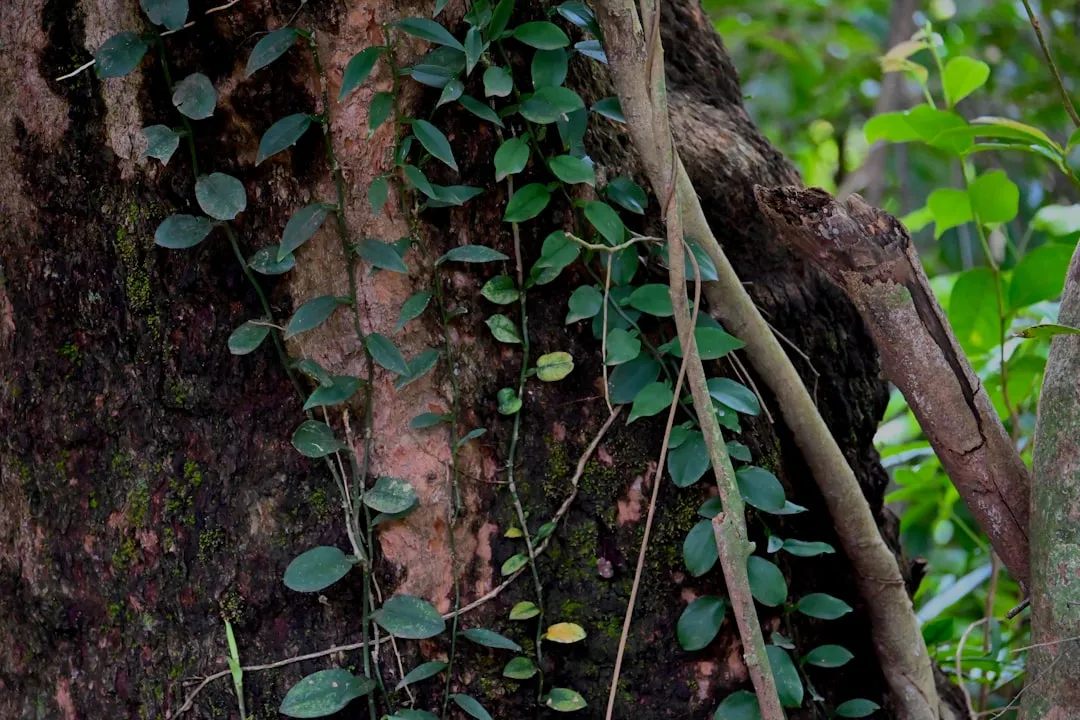
Your pothos is not a hanging plant. Your monstera is not a shrub. Both of them are climbers that ended up in pots, and once you know where they came from, a lot of their odd habits stop being odd.
Monstera starts on the ground and climbs its way up
Monstera deliciosa is native from Mexico to Panama, and it doesn’t spend its life at the size you know it. In the wild it starts as a plant on the forest floor, finds a tree it can climb, and turns epiphytic once it makes contact — growing up the trunk rather than out along the ground, and reaching as much as 70 feet.
That’s the whole design. The stem isn’t built to hold itself up; it’s built to lean on something. Those thick aerial roots pushing out sideways aren’t a defect or a sign of stress — they’re grappling hooks looking for bark.
Pothos comes from a handful of Pacific islands
Pothos — Epipremnum aureum — is native to the Society Islands in French Polynesia, and it has since made itself at home in warm climates all over the world. As a groundcover it stays a modest 6 to 8 feet across. Given something to climb, the same vine can run 40 feet long.
So the trailing pothos on top of your bookshelf is doing the ground-level version of its life: spreading sideways, staying small, waiting to bump into a tree.
Why the wild ones have those enormous leaves
This is the part that surprises people. The dinner-plate monstera leaves and the huge, split pothos leaves you see in photos from Florida or Hawaii aren’t a different plant or a rare variety — they’re the same species, further along.
Both of these plants change what they produce based on whether they’re climbing. Pothos in particular will start producing large, mature leaves once it’s given a support to climb and enough light. A vine hanging in mid-air has no reason to invest in big foliage; a vine working its way up a trunk toward brighter light has every reason to.
It’s the same logic behind monstera fenestration — the holes and splits are a maturity trait, not a random gift. We go deeper on that in why isn’t my monstera splitting.
What this means for your plant indoors
You can’t give it a rainforest, and you don’t need to. You just need to answer the question the plant is constantly asking: is there something here to climb?
Give it vertical support early. Don’t wait for the vine to get long and floppy. A trellis behind the pot gives short new stems somewhere to grab from the moment they appear, and it’s the easiest place to start.
Match the support to the roots. If your plant is throwing thick aerial roots, a moss pole is the better call — those roots can actually grow into damp moss and take up water, which is closer to what they’d do against bark. Our step-by-step moss pole guide covers packing and watering one.
Pair it with light. Climbing support and bright, indirect light work together — support gives the plant somewhere to go, light gives it a reason. One without the other gets you a tall plant with small leaves.
Be patient about the payoff. Bigger leaves come from a plant that has been climbing for a while, not from one that got a pole last month. The first few leaves after you add support usually look the same. The ones after that start to change.
None of this makes your living room a jungle. But it does mean the plant on your shelf is running the same program it ran on a tree trunk in Panama — and giving it something to climb is just letting it.
Ready to give yours something to hold onto? Shop the pieces below.
Photo by Praswin Prakashan on Unsplash.